

Breadmaking machines
by Chris Woodford. Last updated: February 12, 2022.
Freshly made bread is the best thing since—well, the best thing since sliced bread! The only trouble is, it takes time and effort. Most people have never made bread in their lives and would never dream of doing so, but the recent invention of automatic breadmaking machines has started to change all that. Now, millions are turning their kitchens into bakeries and enjoy their own freshly baked loaf each day at a fraction of the cost they'd pay in a store. What's the big attraction of bread-making machines? What are they like and how exactly do they work?
Photo: A typical electronic breadmaker. Unfortunately, this early model has an opaque lid so you can't watch the ingredients slowly transform into a delicious loaf, but most models now have glass lids so you can watch progress in real time. A glass lid means you can spot any problems and abort your baking session; with an opaque lid, you might have to wait five hours to discover that your loaf's a disaster (something a glass lid might have revealed several hours earlier). There is a little dark vent in the center of the lid through which you'll see steam (and smell the aroma of freshly baked bread) escaping!
Sponsored links

Contents
How to make bread (the old way)
Bread is one of the world's oldest and most versatile foods. Just think of all the different types of bread (everything from a basic sliced white loaf to a really fantastic ciabatta or foccacia) and all the different ways we use dough (from simple loaves to rolls and pizza bases). Delicious!
Eating bread is an awful lot easier than making it—and that's because bread-making is necessarily a time-consuming process. Even with the help of an automatic breadmaker, it still takes several hours to make a loaf because it takes that long for the yeast to do its job.
The basic process of making a loaf involves five distinct stages:

- Mixing: You take flour, yeast, water, fat, sugar, and salt and mix them together to make dough.
- Kneading: You have to beat and bash the dough around to make it stretchy and elastic. Without kneading, your dough won't rise and you won't get a decent loaf.
- Rising: Now you leave your dough in a warm place to rise for an hour or more. During this stage, the yeast does its job. Air enters the mixture and makes the dough plump up to about twice the size.
- Knocking down and proving: Some bakers believe you should repeat the rising process a second time to produce a more even loaf. First you bash the dough about to knock the air out of it (which is called knocking down). Then you leave the dough to rise a second time in a tin (which is called proving).
- Baking: Finally, you put the dough in a tin, place the tin in your oven, and bake.
Photo: Making decent bread involves following a sequence of well-defined steps—and that's why a machine can do it just as well as a person: 1) Mixing; 2) Kneading; 3) Rising; 4) Knocking down and proving; 5) Baking. Photos by Jose Jaen, Dylan Butler, Timothy C. Roache Jr., Adam York, Kyle D. Gahlau, all courtesy of US Navy.
How a breadmaking machine works
The great thing about an automatic breadmaker is that it does all these processes for you. A breadmaking machine is essentially a compact electric oven that will hold a single, large bread tin.

Photo: Looking straight down into the breadmaker with the lid open. You can see it's really just a compact oven. There are two heating elements at the side for baking the bread. The round thing in the middle at the bottom is the electric motor that does the kneading.
The tin is a bit special: it has an axle at the bottom that connects into an electric motor underneath. A small metal paddle clicks onto the axle inside the tin. The axle is held by a waterproof seal so none of your bread mixture will escape.
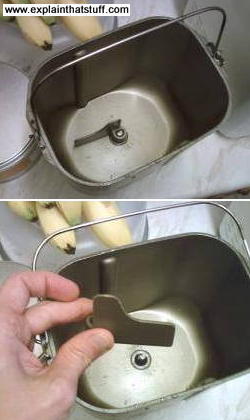
Photos: Top: The kneading paddle in place at the bottom of the tin. Note how the tin has a useful wire handle so you can haul it up out of the machine while it's still hot. Bottom: What the kneading paddle looks like when you remove it. As this turns around at speed, it flings the dough around and kneads it.
So how does it all work? First, you put your paddle in the tin. With the tin out of the oven, you measure out your ingredients and load them up. All you have to do then is pop your tin in the oven, select the program you want using the electronic control panel, close the lid, and wait. If your breadmaker has a glass lid, you can watch what it's doing. If the lid is opaque, you'll have to listen and use your imagination. One of the first things you'll hear is the machine's motor whirring as the paddle spins round, kneading the dough. Then everything will go quiet during the rising phase. Then you'll hear more kneading and another period of quiet during the proving. Finally, the oven will switch on, you'll see steam coming up through the exhaust vent, and you'll start to smell the delicious aroma of baking bread a few minutes later. The basic breadmaking process is largely automatic, but most machines come with recipe books for making more advanced types of dough.
Some breadmakers have other features, such as a built-in memory so they can survive short power outages ("blackouts") of a few minutes: they remember what they were doing and continue when the power returns. Most breadmaking machines also have the ability to make a delayed start, so you can put the ingredients in before you go to bed and wake up to a fresh-baked loaf in the morning. (It's worth noting, however, that if you leave a loaf in a hot machine after it's done it will go on cooking and the crust will become noticeably harder—maybe to your taste, maybe not.)


