Go back in time a century and the idea of keeping fresh food for
more than a few days or so would have seemed not just ludicrous but
positively dangerous: there's no surer way to make yourself ill than
by eating food that's turning bad. Before electric refrigerators were
developed in the early 20th century, people bought their food fresh each day and used
it pretty much straight away. These days, with better technology for
food preservation, some kinds of milk can be kept in a refrigerator for the best part of a month!
It's not just the icebox in your
kitchen that makes this possible but the way the milk (and other
foods) are specially treated before they reach your home. The key is
a process called pasteurization, where fresh foods are heated
briefly to high temperatures, to kill off bacteria, then cooled
rapidly before being shipped out to grocery stores. By greatly
increasing the shelf life of packaged foods, pasteurization has
proved itself to be one of the most important food-preservation
technologies ever developed. Let's take a closer look at how it works!
Photo: Economies of scale: This bottle of pasteurized milk came from my local dairy, Craig's Farm, in Weymouth, Dorset, England, about 16km (10 miles) or so from my home. That's relatively local compared to milk you buy in most grocery stores, which may have traveled hundreds of miles to your home or even been shipped in from another country or continent. Pasteurization means milk keeps longer, but it also means it can be stored longer and shipped further. Good news for the super stores perhaps, and the giant farming corporations, but not so good for small farmers who struggle to compete against mighty corporations and vast economies of scale.
If you think pasteurization is an odd name to give to
heating food, you're right; the process is named for its discoverer,
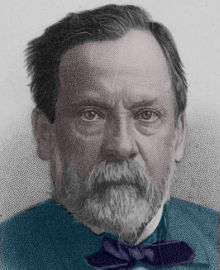
French biologist Louis Pasteur (1822–1895), who stumbled on the idea
in the mid-19th century while trying to discover exactly what made
food go bad. Pasteur had trained in science and was working at the
University of Lille, France when some winemakers invited him to solve
a problem they were having: they couldn't figure out why certain of their
wines were turning bad more quickly than others.
With the help of a microscope, Pasteur discovered that the yeast used in making wine and
beer contains different bacteria. Some of the bacteria helps to
produce the alcohol in the drink from sugar (by a process called
fermentation), while other bacteria turns the drink bad after it's
made. Pasteur's simple solution was to heat the wine briefly to kill off
the harmful bacteria so the drink wouldn't go bad so quickly. This
idea, which became known as pasteurization, proved hugely successful
and was later adopted to help preserve a wide range of other food and
drinks.
Building on his ideas, Pasteur turned his attention to medicine. With other scientists such as
Robert Koch (1843–1910),
he made a number of important contributions to the germ theory of disease: the idea that some diseases are passed between humans when bacteria
carry them through the air.
Photo: A milk production line in a diary. The milk is pasteurized before being loaded into cartons so it keeps much longer. Photo by Donald S. McMichael courtesy of US National Archives.
Sponsored links
How foods are pasteurized
Different foods are pasteurized in different ways. Even milk,
virtually all of which is pasteurized, can be preserved by several
different processes.
Traditionally, ordinary milk was pasteurized in large batches by heating it to
around 60°C (140°F) for 30 minutes or so.
It's also possible to use a faster process and a hotter temperature for less time:
typically heating to 72°C (161°F) for just 30 seconds or so (or two separate periods of 15 seconds),
which means the milk will then keep (in cool conditions) for a
further 7–12 days (starting from when it leaves the processing plant,
not when it arrives in your home).
“Is it safe to consume raw milk? No. FDA and other health agencies such as the Centers for Disease Control and organizations such as the American Academy of Pediatrics agree that raw milk is unsafe because it can contain disease-causing pathogens.”
Photo: Pasteurization kills most (but not all) bacteria. The plate on the right shows bacteria growing from a sample of unpasteurized milk. The one on the left shows milk after pasteurization. Although it's hard to see, there are still some bacteria growing in the unpasteurized sample—just not as many. Photo by Jack Delano, Office of War Administration, courtesy of US Library of Congress.
The hotter the pasteurization temperature, the longer the milk will keep. In a slightly different
process, milk can be pasteurized at a much higher temperature of
about 140°C (290°F) for just 2–3 seconds, producing what's
called UHT (ultra-high temperature) milk that keeps for months
(that's the stuff you get in little plastic containers with foil lids
in restaurants and hotel rooms).
The many other food products that can be pasteurized include almonds, beer, wine, canned foods, cheese, eggs, and fruit juice.
How a pasteurizer works
A typical pasteurizer is completely automatic. You pour milk in
one end and it flows between a set of heating pipes or plates for a
set period of time (long enough to kill off most of the harmful bacteria), then between a set of cooling pipes, before
emerging from an outlet pipe into the bottles. Heating and cooling times and temperatures vary according to the type of pasteurization process being used.
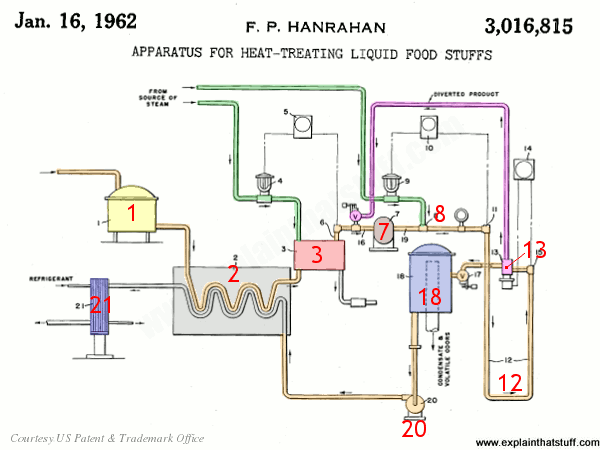
Obviously, that's extremely simplified! In practice, it's a bit more complex and convoluted. Here's an example of a pasteurizer developed by Francis P. Hanrahan for the US Department of Agriculture in the late 1950s, which uses
steam injection to heat the milk. I've colored it to make it easier to follow, but it's not really necessary to go into all the details to understand it completely. Instead, I'm just going to give you a rough idea of the sequence with a few key parts highlighted in red. The milk follows the orange path from left to right and then back again. Steam is injected through the green lines.
Cool raw milk enters through the float tank (1, yellow) on the left at a temperature of about 4–5°C (40°F).
It flows through a heat exchanger called a regenerator (2, gray),
passing close to pasteurized milk that's flowing outward. The two milk pipes exchange their heat: the incoming milk is warmed up
to about 38°C (100°F), the outgoing milk is cooled down.
The now-warmed milk passes through a pre-heater (red, 3), fed by one of the steam pipes (green), and warms to 54°C (130°F).
Now the milk enters the pasteurizing loop (marked out by 7, 8, 12, and 13). It's moved along by a pump (7), more
steam is injected (8) to heat it to 72°C (161°F), and it flows around a long loop (12) for 15 seconds to keep it at that temperature long enough for pasteurization to occur.
At point 13, a valve detects whether the milk is hot enough for pasteurization. If not, it's diverted up around the purple
loop and back around the circuit until it is.
Once the milk has been successfully pasteurized, it flows into a separator (18), still at 72°C, 161°F, where it's flash cooled to about 53°C (128°F) and deodorized.
A pump (20) sends the partly cooled milk through the regenerator (2), so it cools further to 7°C (45°F) as it gives up its heat to incoming milk.
A refrigeration unit (21) chills it to its final temperature for bottling and/or longer-term storage.
Photo: You might think of milk production as a romantic rural adventure involving
happy, snuffling cows. But, in fact, pasteurizing has been an industrial-scale, factory process for many decades.
Here's a typical pasteurizing plant photographed way back in 1941.
Photo by Russell Lee, U.S. Farm Security Administration/Office of War Information, courtesy of US Library of Congress.
Who invented the pasteurizer?
Although Louis Pasteur discovered the heat-treatment process that bears his name, the machines
that carry out the process—pasteurizing large quantities of milk and other foods—were developed by
other people. A quick search of the inventions on file at the US Patent and Trademark Office reveals
dozens of different pasteurizing machines.
Photo: Merchant and philanthropist Nathan Straus and his wife set up their Pasteurized Milk Laboratory to provide safer milk to children in 1892 with the hope of reducing infant mortality and tuberculosis. This picture shows some of their staff and equipment. Photo by Bain News Service courtesy of Library of Congress Prints and Photographs Division.
Numerous machines specifically designed for pasteurizing milk seem to have appeared between the 1890s and 1910s, including
Enrique Taulis's Process of and apparatus for sterilizing milk
(patented in Chile in 1894 and in the United States in 1896) and
Jacob Woodyard's Device for heating, aerating, and cooling milk
(from 1895). Some of the inventions incorporated pasteurization into ingenious food-processing contraptions,
including Darius Payne's Combined pasteurizer, cream ripener, churn, and butter worker (from 1901). People are still developing new kinds of pasteurizers to this day: like heat-treated milk, ingenious ideas can last a very long time!
Photo: Steam pasteurizer: A typical early pasteurizing machine, developed by Aage Jensen of Topeka, Kansas in 1903. This one uses a steam-driven motor and pulley (green) to power an agitator that turns the cream inside
a cylinder (blue) at several hundred times a minute. The exhaust steam from the motor feeds into the cylinder to heat and pasteurize the cream, which then leaves by the orange pipe near the top. Artwork courtesy of US Patent and Trademark Office with coloring and annotations by Explainthatstuff.com. You can find full details of this invention in US Patent #745,105: Pasteurizer on Google Patents.
How Pasteur's Artistic Insight Changed Chemistry by Joanna Klein, The New York Times, June 14, 2017. A look at Louis Pasteur's early work on chirality (how molecules have mirror-image forms with different properties).
Germ theory by Harry Burn, BBC News, January 5, 2007. The Chief Medical Officer for Scotland explains why the development of germ theory was such an important milestone in medicine.
Beer technology creates 'supermilk': BBC News, January 19, 2001. Announcing the development of PurFiltre milk, which uses a ceramic filter to remove bacteria instead of high heat treatment.
Germ Theory by Judith Herbst. Twenty-First Century Books, 2008. An easy-to-understand, 80-page primer on the history and science of germ theory. Suitable for young teenagers.
For older readers
Germ Theory: Medical Pioneers in Infectious Diseases by Robert P. Gaynes. American Society for Microbiology, 2011. Reviews the lives of 12 pioneers of germ theory, including Pasteur, Jenner, Lister, and Fleming.
Great Feuds in Medicine: Ten of the Liveliest Disputes Ever by Hal Hellman. John Wiley & Sons, 2001. Chapter 5 recounts criticisms of Pasteur's work that are often omitted from simple, popular accounts, including his fierce battles with chemist Justus von Liebig and physician Robert Koch.
The Private Science of Louis Pasteur by
Gerald L. Geison. Princeton University Press, 1995. Have Pasteur's achievements been overstated? This scholarly biography examines his laboratory notebooks to probe the hidden story behind a scientific hero.
Please do NOT copy our articles onto blogs and other websites
Articles from this website are registered at the US Copyright Office. Copying or otherwise using registered works without permission, removing this or other copyright notices, and/or infringing related rights could make you liable to severe civil or criminal penalties.