A decade or two ago, the telephone wire heading into your home was a
quaint way to chat with your family and friends when you couldn't speak
to them in person. The basic idea hadn't changed much since the 1870s,
when Alexander Graham Bell (1847–1922) and others pioneered telephone
technology. But in the 21st century, people have started to see
telephone lines a different way: now they're broadbandInternet connections, piping
music downloads, YouTube videos, news, and information—as well as
telephone calls—into our homes 24 hours a day. Streaming media (a way
of playing files as they download) has been a central part of this
information revolution. What is it, exactly, and how does it work?
Let's take a closer look!
Photo: TV and movies as many of us now see them: streamed through a laptop or cellphone screen.
If a picture is a worth a thousand words, a moving picture is worth
a million. But how do you cram all that information down a telephone?
The trouble is that a couple of copper wires—the basic technology
behind our home phone lines—cannot, ordinarily carry information
quickly enough to bring things like radio and
TV into our homes. If
you've ever watched a fax machine chugging along, sending or receiving
a printed document at a grindingly slow speed, you'll know just how
slow telephone lines can be at carrying anything other than a person's
voice (the only job they were ever designed to do).
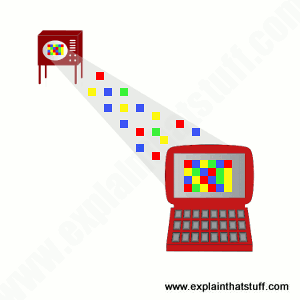
Artwork: The concept of streaming media: transmitting a movie, TV program, or other video across the Internet for viewing on a PC or mobile device.
In the days when most people had dial-up
Internet connections (where you make a connection to your Internet
Service Provider using a modem to enable what is essentially just a normal telephone call), slow speeds were a
major limitation on what could be done online. If you wanted to listen to
an MP3 music track
(typically about 5 megabytes in size), you could spend half an hour
waiting for the entire file to download onto your hard drive, then open
it up and play it back. Video files (more likely to be 50 megabytes)
would take several hours to download this way, so they were not
generally available on the Net. In those days, it was impossible to
listen to a music or movie file of any size without a long and tedious
wait. The problem was essentially a matter of bandwidth: the speed of
an Internet connection (how quickly it can download information) sets
a limit to how quickly you can transfer a file.
In the mid-1990s, in the early days of the Web, Rob Glaser and his
Real company (originally called Progressive Networks) pioneered
streaming media as the solution to this problem. The basic
idea is simple. Suppose you want to watch a large video file on your
PC. You install a media player
(a streaming-media-playing program) on your computer that plays the
file while it downloads. So it downloads maybe the first 10 seconds of
the file, stores or buffers it, then immediately starts to play it.
As the media player starts playing the first part of the file, it's also downloading
the next 10 seconds ready for when you come to that bit. The media player
never actually stores more than a little bit of the entire file: once
it's played part of the file, it deletes it to make way for the next bit. If the media player
can download the file as fast as you're watching or listening to it, you'll see
no interruptions; if there are delays in downloading for any reason, there will
be occasional pauses while the player downloads and "buffers" the next bit of the file.
Photo: Streaming media as it used to be. This is an early version of RealPlayer (the program that
kick-started the streaming media revolution) playing here over a 56 Kbps
dial-up Internet connection. The status bar at the bottom shows the radio station is being
played at 44.1 Kbps (over 44,000 binary digits per second), which is well
within the limits of the connection. The trick with streaming media is for the player to
adapt to the limits of your Internet connection to avoid excessive buffering.
Although modern fiber broadband connections have about 1000 times the bandwidth of dialup,
buffering can still be an issue because people download much bigger files (HD movies) these days.
Sponsored links
Downloading and streaming compared
Before we go any further, we need to know more about how the Internet works.
Data (computerized information) moves efficiently across the Internet by being broken up into little bits
known as packets. Each packet is independently addressed and travels separately,
and different packets can travel by very different routes. Imagine yourself wanting to send a
really heavy textbook to a friend in another country. Instead of sending the entire book,
you tear it into separate pages, put each one in its own envelope with a separate stamp and address,
and mail all those envelopes one after another. Your friend may receive them at slightly different times, in the wrong order, but
she can easily reassemble them into the book. Why would you mail a book in such an odd way? It turns
out the Internet works best this way with everything broken into small, similar-sized chunks. (We have a whole
article about how the Internet works that explains all this in more detail.)
When you download a file in the traditional way, you're effectively asking another computer (a server
that sends out files to many different people) to send you zillions of packets one after another and you have to wait for
all of them to arrive before you can do anything with any of them. With streaming, you start to use the packets as soon
as enough of them have arrived. That's the essential difference. You can think of streaming as playing during downloading, but in fact the two things
are different in all sorts of ways:
Speed
Downloading: Unpredictable: Download time is unrelated to playing time. A music album could
download in 5 seconds, 5 minutes, or 5 hours depending on its size, your net connection,
and web traffic.
Streaming: Real time: Generally, a 1 hour video will stream in roughly 1 hour (though there may be
occasional delays caused by buffering); unlike downloading, streaming media can be used for "live-live"
transmission of events as they happen (also known as webcasting).
Quality
Downloading: Uses traditional Internet packet communication (technically known as TCP/IP) with a
system that automatically corrects errors. Any lost or damaged "packets"
(downloaded chunks of data) are retransmitted. The file you eventually receive on your computer is
an exact copy of the file that was on the server.
Streaming: Packet losses are ignored (lost and damaged packets are not resent), but that doesn't usually matter because digitally streamed video and audio is converted back into analog format before we watch it or listen to it. Any packets lost during streaming simply add "surface noise" to an audio stream or degrade the picture quality of a video (for example, with excessive pixelation (where the picture disappears into square blocks).
File type
Downloading: A download is a single file with all the relevant data packaged together. So if you're downloading a movie, everything is packaged into a single movie file with a filetype something like MPEG4.
Streaming: If you stream a movie, each different part of the movie (sound, video, subtitles, or whatever) is transmitted as a separate stream. The movie player reassembles and synchronizes the streams as they arrive at your computer. In terms of bandwidth, these multiple streams are additive: if you're
back in the Dark Ages with a slow 56 Kbps dial-up modem, you could happily watch a 20 Kbps audio stream and a 30 Kbps video stream together, but any extra streams would cause periodic pauses and buffering.
Servers
Downloading: Downloads work through traditional web-serving methods (technically known as the HTTP and FTP protocols) with any conventional web server. The same version of each file is served to everyone.
Streaming: Streams use RTSP (real-time streaming protocol) and need to run on a server specially geared for streaming. When you go to a web page
that offers streaming media, you're generally redirected to a separate streaming server. There are typically different versions of each
file that have been optimized for different connection speeds (for example, a low-quality version for dial-up and a high-quality version
for broadband); in practice, different files are served to different people.
Encoding/decoding
Downloading: Files can be instantly uploaded to a server for immediate downloading.
Streaming: Files have to be compressed (perhaps using smaller video frames or fewer frames per second) and then encoded (turned into discrete, digital packets) before they can be streamed. People watching or listening to streamed files have to have appropriate
decoding files installed on their computers (known as codecs) for turning encoded, computerized, digital files back into analog sounds and pictures that human ears and eyes can process. In practice, that means you need a plugin in your web-browser to handle whatever streaming media files you want to receive (and you'll need separate plugins for QuickTime, RealPlayer, and so on).
Multiple users
Downloading: The more people ("clients") download a file at the same time, the harder the server has to work, the slower it works for each client, and the longer it takes you to download—irrespective of how fast an Internet connection you have.
(BitTorrent offers one solution to this problem.)
Streaming: In traditional streaming (unicasting), each client takes a separate stream from the server—necessarily, because different people will start streaming the same video or audio program at different times. Multicasting is a more efficient kind of streaming that allows a streaming server to produce a single stream that many people can watch or listen to simultaneously—for example, if lots of people are watching a football game live online at the same time. Some media players automatically use multicasting when they can.
Standards
Downloading: Downloaded files tend to be in standard formats (such as MP3) that play easily on any computer or operating system.
Streaming: There are three rival, proprietary streaming systems (more formally known as architectures—RealPlayer, Apple QuickTime, and Microsoft Windows Media Player), and though they're much more compatible than they used to be, it's not always possible to play files designed for one player on the others.
Copyright
Downloading: Downloaded files are, by definition, copied onto the viewer's computer. They're easy to email, post on other websites, and repackage or resell—causing major copyright issues.
Streaming: Streamed files are downloaded a little bit at a time and deleted as soon as they're played.
In theory, nothing remains on the viewer's computer so there are fewer copyright issues. (In practice,
programs have been written that can record streamed files.)
Examples of streaming media
Photo: Netflix, the world's biggest and best-known streaming service, now has close to 200 million subscribers worldwide. It streams movies and TV programs down your Internet connection in "real time." That means programs play at the same rate they download, and each program takes roughly the same time to watch via streaming as it would if viewed live on your television.
Genuine streaming
Photo: Genuine streaming: YouTube uses a type of streaming that continually adapts to the speed and quality of your Internet connection; previously it used progressive downloading (described below).
Netflix and YouTube currently use what's called adaptive bitrate streaming, which constantly adjusts ("adapts") the stream rate to the quality of your Internet connection and the performance of your computer. It's based on the ordinary method of
sending packet data across the Internet (hypertext transfer protocol, HTTP), so it's better suited to sending data over the Net than older streaming "protocols" such as RTP (real-time protocol), used by early streaming players such as Real (described
in the box below). One advantage is that it can cope with mobile networks that may switch back and forth between high (5G and 4G) and slower (3G) speeds as you move around.
Most Internet radio stations use either this kind of adaptive (HTTP) streaming or older-style
(RTP) streaming, where programs are downloaded and played simultaneously in your web browser,
with a dedicated app, or with a program like RealPlayer, Apple's QuickTime, or the Microsoft Windows Media Player. With a decent broadband connection, you can enjoy audio quality that's not far off the quality you get from a downloaded
MP3 sound file (though, as we discuss in our article on MP3, that's never quite as good as you'd get from a CD). As Internet connections have become faster, and more people have broadband, it's become possible to watch videos and TV programs this way too, though unless you stream in high definition over a really fast broadband line, quality is still short of what you'd get from watching TV or a DVD. That's
one reason why online movie stories still sometimes use downloads instead of streaming.
Pseudo-streaming: progressive downloading
Not all websites that appear to stream video work by streaming.
Some actually use an alternative approach called progressive downloading
(fast-start streaming), which is like a cross between conventional downloading and streaming
(YouTube used to work this way until a few years ago).
It's popular because it's often quicker and easier to implement than genuine streaming.
A large chunk (and sometimes all) of the file you're watching downloads into your web browser's cache (its internal working memory buffer) and your browser plays it simultaneously. Unlike with a truly streamed video, you can't
always skip forward: generally you have to wait for the file to download to the point you want to see. Another key difference
is that the file remains in your browser cache even when you've finished watching. You can tell when a website
is working by progressive downloading because the video window will show two separate indicators on a progress bar,
like the one below: one shows you how much of the file has downloaded, while the other shows how much you've played.
Until recently, almost all progressive downloading used Macromedia Flash files (with SWF or FLV extensions),
that are served from a conventional web server and played on a Flash plugin installed in your browser.
Following the arrival of HTML5, modern browsers (including the slimmed-down ones on smartphones)
can now do this themselves without using Flash at all.
Photo: A progressive downloading progress bar. When you see this, you're not actually streaming a video—you're playing it as you download the entire thing. If you know how to look in your browser cache, you'll probably find the file is sitting in there somewhere after you've played it (look for a very big file or one with a very new date and time, but don't expect to find a meaningful filename or extension).
How Real streaming works
The artwork below, taken from Rob Glaser's original patent, shows how streaming media was originally designed to work.
The figure on the left shows how sound is packaged and sent as digital data to your computer (the purple box at the bottom); the one on the right shows how your computer receives, unpacks, and turns this data back into sound. Let's look at these two steps (transmission and reception) in a bit more depth.
Live or recorded sound (red boxes) is made from analog (continuously varying) sound waves.
So, at the transmitting end, the first step is to convert these waves into digital data using an analog-to-digital converter (green). If the source of sound is digital to begin with, we can miss this step out. Next, the digital data is compressed (orange) by over 95 percent (in the original patent, they quote a figure of 22:1) so it can be transmitted more quickly. The compressed digital data is stored (light blue) and then progressively transmitted by a server (dark blue) over the Internet (yellow) to your PC (purple). Of course, there's no reason why
lots of programs can't be compressed and stored indefinitely in a library and then streamed whenever people want to listen to or watch them, but don't forget that Real Player was originally designed so it could
stream things like live radio shows as they were transmitted from the studio. It's also worth noting that
the original version of Real Player shown up above was designed to be able to send real-time audio across grindingly slow dialup Internet connections (as slow as 14.4 Kbps); modern streaming can send high-definition video over broadband connections hundreds or thousands of times faster, but works in essentially the same way.
Reception
Inside your PC, a similar process runs in reverse to turn the digital data you receive back into sound.
Packets of data are received down a phone line from the Internet (yellow) and stored in buffers (small bits of DRAM memory, blue). The buffers are designed to be as full with data as possible: if they're too empty, because the audio isn't being transmitted fast enough, there's a risk of the audio playback being interrupted (which is when you see the annoying "Buffering" message). The data from the buffers is decoded and decompressed (orange) and passed to a wave driver in a sound card (light gray), which generates streams of audio still in digital format. A digital-to-analog converter turns these streams into analog signals that power a loudspeaker, hopefully recreating a faithful version of the original sound (red).
What about errors?
Garbage in, garbage out—so goes the old saying in the computer business. So if the data from the "transmitting" server gets corrupted, won't you hear poor quality audio from your loudspeaker?
The modems sending and receiving data use error control/correction protocols to ensure that the data that's received is the same as the data that's transmitted.
Where next for streaming media?
Streaming media—bringing music and videos on demand—has advanced
dramatically since I wrote the first version of this article in 2007.
Back then, I wrote:
The audio and video information you
download has to be compressed dramatically (substantially reduced in quality to make smaller
files) so it downloads in a reasonable amount of time. Most streaming videos are still quite small and "pixelated"
(full of obvious square blocks) when they play on something like
YouTube. That's because even today's best broadband connections are not
fast enough to download the huge amount of information in a fullscreen, high-definition
TV picture. In a few years time, when broadband connections are many times faster, it will be possible to
stream HD-quality video over the Net. Then the age of information-on-demand really will have arrived!
How times have changed! According to the
ITU-T as of 2022, 66 percent of the world's people have Internet access and global Internet bandwidth is
growing at about 30 percent a year.
More users with more bandwidth, most using modern browsers that handle HTML5 (with "native" support for video), have made possible ever greater use of streaming media.
Collectively, the world now watches well over
a billion hours of YouTube per day (a milestone passed in 2017), while
Facebook Video has rapidly become one of the most used features of the world's favorite social media platform since its
2015 launch. Back in 2017, the Pew Research Center discovered that online streaming is how a majority (almost two thirds) of young adults (aged 18–29) watch their TV programs.
That's largely due to services like Netflix, the world's most popular streaming movie service, which had reached
238 million subscribers by summer 2023; many of its movies and TV shows are available in HD.
Online gaming is another major driver of streamed traffic: gamers watched 21 billion hours of live-streamed content on Twitch in the third quarter of 2022 alone.
However, streaming isn't just confined to "disposable entertainment":
in 2020, the Pew research team noted that YouTube supplies news to a quarter of US adults, while 72 percent believe it's either their "most important" or "an important" source of news.
All told, reliable, affordable, high-quality streaming of audio and video is now the norm;
two decades ago, when Rob Glaser was granted his original streaming-media patent, it would have seemed like a very distant dream.
Screenshot: Since its launch in 2011, Twitch has rapidly become one of the world's biggest content-streaming platforms.
Sponsored links
Find out more
On this website
Broadband Internet (general introduction to broadband and how it differs from dial-up)
10 facts about Americans and YouTube by Kristen Purcell, Pew Internet & American Life Project Report, December 4, 2019. Three quarters of Americans use YouTube—and other fascinating facts.
The State of Online Video by Kristen Purcell, Pew Internet & American Life Project Report, June 2010. A review of social trends in Internet video.
Books
Streaming Systems by Tyler Akidau, Slava Chernyak, and Reuven Lax. O'Reilly, 2018. One of the most up-to-date technical guides.
Streaming, Sharing, Stealing: Big Data and the Future of Entertainment by Michael D. Smith and Rahul Telang. MIT Press, 2016. Much more of a business book than a technical guide, this offers an insight into how data analytics, subscription-payment, and on-demand viewing power the business models of streaming companies like Netflix and Amazon.
Streaming Media by Tobias Künkel. Wiley, 2003. A detailed technical guide for streaming media producers.
Streaming Media Bible by Steve Mack. Wiley, 2002. Now rather dated, but still worth a look.
Articles
A Thumbs Down for Streaming Privacy by Shira Ovide. The New York Times, August 24, 2021. A new report finds that most streaming services fail to meet basic privacy practices.
Dirty streaming: The Internet's big secret by Hannah Livingston. BBC News, March 5, 2020. Data centres, serving our ever-increasing streaming, are among the planet's fastest-growing energy consumers.
Please do NOT copy our articles onto blogs and other websites
Articles from this website are registered at the US Copyright Office. Copying or otherwise using registered works without permission, removing this or other copyright notices, and/or infringing related rights could make you liable to severe civil or criminal penalties.