The way we love our remote controls,
you'd think our living rooms were the size of Texas! It's an awfully long way to
go, isn't it, to change the television
channel or pump up the volume on the
stereo? Remote controls are a perfect indulgence for couch potatoes
everywhere—but have you ever stopped to wonder how they work? How
come your TV remote doesn't trigger the video? Why do you have to
point it directly at the TV? And when you aim your remote at a
neighbor's house, does their TV channel change too? Let's take a
closer look at the mysteries of remote control!
Photo: A typical TV remote control unit. Early TV remotes did little more than change the channel. With a modern remote control, you can control virtually every aspect of how a TV works. This remote can also control a
DVD player hooked up to the TV set.
Photo: The small infrared LED on the top of a
typical remote control.
The first thing you notice about a remote control
unit is that it has no wires, so it has to send signals to whatever
it's operating using electromagnetic waves.
Light, X rays,
radio waves, and microwaves are all examples of electromagnetic
waves: vibrating packets of electrical and magnetic energy that
travel through the air at the speed of light. Most remote controls
send signals using infrared radiation (which is a kind of invisible
red light that hot objects give off and halogen
hobs use to
cook with), though some use radio waves instead.
If you look at the top of your remote control
unit, you'll see there's a small plastic light-emitting
diode (LED) where the infrared radiation comes out. Now take a look at your
TV or video. Somewhere on the front, there's a very small infrared
light detector. When you press the remote control, a beam of infrared
radiation travels from the remote to your TV at the speed of light
and the detector picks it up.
Human eyes can't detect infrared, so even if you
press the buttons on your remote and stare at the LED you won't see
anything happening. Some animals, including rattlesnakes, can detect infrared. Rattlesnakes have tiny
infrared detectors buried in pits near their eyes, which work
a bit like the infrared detectors on your TV.
By homing in on infrared heat, snakes can locate prey at night when
there's no
ordinary light to see by.
What would
happen if you pointed a TV remote control at a snake and pressed the
buttons? Maybe it would think you were a mouse and slither over to
eat you. It's unlikely you could control a rattlesnake with a TV
remote—and we don't recommend you try!
Photo: Rattlesnakes "speak" infrared, just like TV
sets. Picture by Gary Stolz courtesy of US Fish & Wildlife Service.
Sponsored links
Remote control codes
It's no good the remote control just sending out a
burst of random infrared. Clearly if your remote control has 20 or
more buttons on it, it must have a way of sending out at least this
many signals—each one different enough for your TV to be able to
decode and understand it. When you press one of the buttons, the
remote generates a systematic series of on/off infrared pulses that
signal a binary code (a way
of representing any kind of information using only zeros and ones,
which computers use). So a short
pulse of infrared
could signal a 1 and no pulse could signal a 0. Sending many infrared
pulses, one after another, allows your remote to send whole strings
of zeros and ones. One code (maybe it's 101101) might mean "volume
up", while another (perhaps 11110111) could mean "mute sound."
As well as sending out pulses that tell the TV
what you want it to do, the remote also sends a short code that
identifies the product you're trying to control (for example, a
specific make and model of TV). That ensures your remote operates
only the TV, not the video, and not any other TVs that happen to be
nearby. Generally, this means each remote control unit can operate
only one appliance made by only one manufacturer. Of course if you
could discover the codes that different TVs and videos understand,
you could build a remote control that operated any appliance. This is
how universal remotes work. They let you
control any TV or
video and, instead of sending out only signals specific to one brand
of equipment, they can send out codes that any make or model can
understand. One inventor has even gone so far as to develop a remote
called TV-B-Gone that systematically sends out a "switch TV off" signal using
every possible manufacturer's code. It's designed to allow TV haters
to switch off annoying TVs covertly as they wander through shopping
malls and department stores!
Screenshot: Turn your smartphone into a remote control. If your phone has a built-in infrared transmitter, you can use it as a remote control. Here's my Android phone set up with an app called Quick Remote to behave like a Sony TV remote control. Apps like this can control TVs, set-top boxes, stereos, air conditioners, projectors, and pretty much anything else for which you can figure out the right infrared codes. Unfortunately, iPhones don't have IR transmitters so, if you're an Apple fan, you'll need to get an adapter if you want to do this sort of thing with your phone.
Can I switch on my neighbor's TV set?
Infrared remote controls are relatively low powered and will send signals
only about 10–20m (35–70ft). Like visible light, infrared is relatively
low-energy electromagnetic radiation and, unlike radio waves, cannot penetrate
through solid walls. That means there's no chance your ordinary infrared remote
will switch on your neighbor's TV or DVD recorder by accident!
If you do want to operate equipment in other rooms, it's possible to buy radio-frequency
remote controls (and adapters for conventional, infrared remotes) to extend their range.
A typical RF remote might operate in the frequency range 400–450 MHz, where an ordinary infrared
remote would operate at perhaps 300 THz (3 × 10¹⁴ Hz = 300 million million hertz)—roughly
a million times higher frequency. With equipment like this, it is possible to receive signals
from a neighbor's home, much like you can receive their wireless Internet (Wi-Fi) signals.
Who invented the remote control?
US electrical engineer Eugene Polley (1915–2012) came up with the idea for an electronic remote control system years before many people even owned a television. And here it is, as drawn by the inventor himself! What we have to remember is that mid-20th-century televisions were nothing like as sophisticated as modern ones. Although they were essentially electronic, they still had mechanical tuning systems (so you turned a clunky dial to make the tuner switch from one receiving frequency to another, much like you still do with analog radio sets to this day). That meant Polley's remote control was a part electronic, part mechanical device, and quite a bit more cumbersome than the ones we have now, although no less ingenious.
Artwork: The original electronic TV remote control, from US Patent 2,903,575: Control system by Eugene J. Polley, Zenith Radio Corporation, filed on May 6, 1955 and granted on September 8, 1959. Courtesy of US Patent and Trademark Office.
How did it work? You pointed a simple handheld flashlight (labeled 30, "light source") at one of four photoelectric cells (shown here in green and numbered 17, 18, 19, and 20), each of which was linked to a separate electronic switch (numbered 23, 24, 25, and 26) and controlled a separate function of the TV. On the top left, 17 operated an electric motor, 27, which automatically turned the TV tuner dial to a higher frequency. On the top right, 18 turned the dial the opposite way. On the bottom left, 19 switched the TV on or off. And on the bottom right, 20 adjusted the audio volume. Everything was controlled through electronic circuits in the blue box marked 21.
Radio control
Infrared remotes can operate TVs and videos only
over quite short distances. The infrared LED is quite small and
low-powered and the receiver on the TV or video is small too. This is
why you generally have to point the remote directly at the appliance
you're trying to control. Some remotes are more tolerant and it is
sometimes possible to bounce the infrared beam off a wall, mirror, or
picture and still change channel. Infrared remotes are no good for
controlling things over distances greater than a few meters (feet);
the infrared energy is too easily soaked up and dissipated along its
journey.
To control things over greater distances, you need to use a
different kind of system called radio control.
You operate
radio-controlled cars, trucks, boats, airplanes, and robots using a
handheld radio transmitter box that sends signals from an
antenna on
the top to a matching antenna on whatever you're interested in
controlling. Radio signals can travel much further than infrared ones
without interference, especially if the transmitters and antennas are
large and powerful.
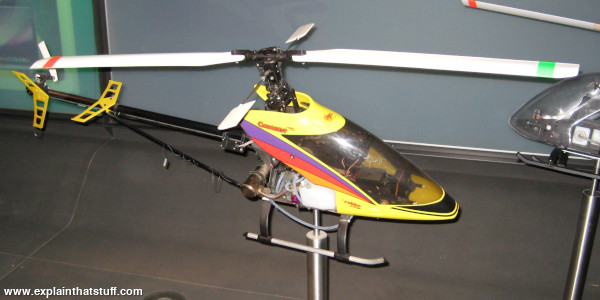
Photo: A typical radio-controlled helicopter. Inside, the
"passenger compartment" is packed with radio-receiver electronics, a motor that spins the main rotor, and servo motors that control the
steering (rotor pitch) in exactly the same way as a real helicopter's. This is an exhibit at the
Think Tank science museum in Birmingham, England.
Who invented radio control?
It was Nikola Tesla—with this ingenious toy boat,
patented in the United States in 1898. An antenna (1) picks up radio signals that control the motor (2) and battery (3) that power the boat's propeller (4). A second motor (5) controls the rudder (6) that steers the boat.
“I require no intermediate wires, cables, or other form of electrical or mechanical connection with the object save the natural media in space... My invention... involves the production of suitable waves or variations and the conveying of the same to a remote receiving apparatus capable of being operated or controlled by their influence.”
Nikola Tesla, inventor of remote control, 1898
So radio control, which seems pretty modern, has actually been around well over a century. The photo below shows how it was being used to drive a full-sized automobile in Washington, DC way back in 1928! The man on the right is holding the radio-control unit with an antenna you can just about make out poking out from the top. You can also see a small receiver unit picking up signals from the man's controller on the running board of the car to the left.
There are two broad types of radio control known as single channel and multi-channel.
Single-channel radio control
is effectively an on-off switch operated at a distance by radio wave. So, to give a very trivial example, you could use a single-channel control to
switch a lamp on or off at the bottom of your garden. The sender unit would consist of a low-powered radio transmitter, while the lamp would need a radio receiver and a relay (to convert the low-powered, incoming radio signal into a higher-powered electric current big enough to operate the lamp). Single-channel radio control can only switch things completely on or completely off; it can't turn them up or down by degrees.
Multi-channel radio control is used to transmit more complex and useful signals to a piece of remote equipment—for example, to make a radio-controlled car speed up, slow down, or steer from side to side. Instead of just sending a basic on/off signal, it transmits a series of coded analog or digital pulses that are decoded by the receiver and used to produce specific actions. For example, turning a steering wheel on a radio-control transmitter will send a series of pulses that make an
electric motor rotate by a corresponding amount to steer a radio-controlled car one way or the other. Motors that work this way are known as servo motors. Unlike normal electric motors, which rotate an arbritary number of times according to how long they receive an electric current, servo motors are much more controllable and have built-in electronic feedback mechanisms (based on potentiometers—similar to variable resistors), which enable you to make them rotate by reasonably precise amounts.
What is radio control used for?
Radio control isn't just used in toys; many of the
latest wireless gadgets use similar technology, including
Bluetooth®
(a convenient way of operating computer-based equipment without
wires), RFID (radio frequency identification)
technology used
in anti-shoplifting systems, and Wi-Fi, used in wireless Internet.
Even cellphones communicate using a
wireless system not unlike
radio control. So maybe remote control isn't just for couch potatoes
after all?
How to repair a broken TV remote control
With no moving parts, you might think a remote control would last forever. But all that pushing and poking eventually takes its toll. One day, you may find your remote stops working: the buttons you press no longer do anything, no matter how hard you prod them.
This can be a real nuisance, because chances are your TV is now obsolete and the remote you need is
no longer manufactured. Fortunately, it's often possible to repair a defunct remote. If the entire remote stops working, most likely the batteries have gone. That's the first, most obvious thing to test before you go any further.
If only a couple of buttons have gone—typically the volume up/down or channel buttons, or other
buttons you use most often—you have a different problem. Remotes are built around a rubber membrane keypad. Each key is part of a single, large piece of rubbery plastic. Under each one, there's a thin
strip of conducting paint or plastic. When you press the key down, the conducting material bridges contacts on the printed circuit board directly underneath, completing a switch and activating the circuit. In the top photo here, you can see the membrane keypad (second from the right) and the circuit board it sits on (second from the left). Over time, a thin greasy film builds up between the bottom of the keys and the top of the circuit board. I'm not sure what causes this, and it doesn't really matter (probably as the current flows through the conducting material on the base of the key it warms up slightly and that gradually degrades the material). This film acts as a barrier between the base of the key and the circuit board and stops the keys from completing the circuit.
How to fix it? First, remove the batteries. Next, carefully open the case of your remote. You'll either have to undo some screws or, with a remote like the one shown here, separate the top of the case from the bottom with a thin, flat screwdriver. Generally, if there are no screws, there are several plastic clips holding the two parts together and you need to find them and push them gently to open the case. Go carefully! Once you've taken the case apart, separate out the layers as I've done here. Inspect the circuit board, particularly the bits of the board that are directly underneath the buttons that aren't working. See a film there or a dirty deposit? Put a small amount of detergent and water on a cloth and carefully wipe it away. Don't use anything abrasive. Gently wipe the bottom of the rubber membrane keys to remove any film from there too. Do this very carefully so you don't damage or degrade the conducting layer. Make sure the whole thing is completely dry, reassemble it, and you may well find it works again.
If it still doesn't work, the conducting layer on the base of the non-functioning keys has probably worn away. (If you have a multimeter, you can test the bottom of the keys to see if any current flows, and establish that this is the fault beyond doubt.) You can buy repair kits and conducting paint pens to touch up the damaged layers, but they're quite expensive and it might not be worth the bother. In theory, you could use a soft graphite pencil to make a temporary repair, but that's unlikely to last very long. Another option might be to transplant one of the working keys to replace the broken ones, but since these keypads are built from a single piece of material, that's going to be a slightly tricky operation involving rubber surgery!
A simpler alternative is simply to find the model number from your remote and type it into eBay or your favorite auction site. You might well find a replacement someone no longer wants.
How To Radio Control DC Motors Cheaply: An introductory project showing you how to use an off-the-shelf radio transmitter to control motors (from the Instructables website).
Build your own radio remote control by Howard G. McEntree. Popular Mechanics, August 1964. A great "retro" article from yesteryear that gives a fascinating insight into what hobbyist electronics was like a few decades ago!
22 Radio and Receiver Projects for the Evil Genius by Thomas Petruzzellis. McGraw Hill Professional, 2008. A collection of easy-to-build projects involving sending or receiving radio waves, including various kinds of radio receivers and detectors.
Remote Control Robotics by Craig Sayers. Springer, 1999/2012. A basic introduction to the real-world problem of operating robots remotely in often unpredictable environments.
Remote Control by Robert W. Lucky. IEEE Spectrum, March 1, 2006. An electronics engineer discovers a new respect for the humble household remote.
Please do NOT copy our articles onto blogs and other websites
Articles from this website are registered at the US Copyright Office. Copying or otherwise using registered works without permission, removing this or other copyright notices, and/or infringing related rights could make you liable to severe civil or criminal penalties.