When a car screeches round a bend at high speed, the only thing that stops it skidding is the friction between its tires and the road—a force that
can be several times greater than its weight.
[1]
Here friction is
working like a kind of glue that sticks the car to the road, but it's
not always so helpful. Under the hood, friction is busily wearing out
the engine parts—it's one of the main ways that a car wastes
energy. That's why we need lubricants: substances that fight friction and allow
moving machine parts to slide past one another more smoothly.
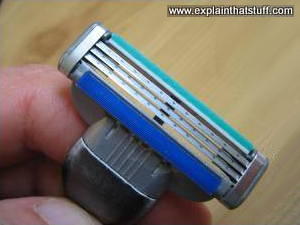
Photo: Lubricants crop up in some unusual places. Safety razors like this usually have some lubricant on them so they move easily over your face. The lubricant is the green strip at the top. When the razor gets wet, it turns into a greasy cream that makes it glide more smoothly over the hairy skin that's heading toward the blades.
Friction is caused by forces between two things when they touch, like when you
drag your foot along the sidewalk and feel and hear the surfaces
scuffing together. It doesn't matter how smooth things look or
feel—peer at them under a microscope and you'll see they're always
rougher in close up. When you drag your foot on the ground, the
jagged bits on the two surfaces snag against each other, slowing you
down and stealing your energy.
For something like a machine with moving parts that rub against one
another, friction can be a real nuisance: the rougher the touching surfaces, the
more friction there is, the harder the machine has to work,
the more quickly it wears out, the hotter it gets, and the more energy it wastes.
Artwork: Friction has its uses. Without it, walking
would be impossible: your feet wouldn't grip at all, and you'd slide all over
the place—just like you do on ice. When you put your foot down to walk, the rough lower surface of your shoe grips the rough upper surface of the sidewalk, stopping you from slipping backward. That helps you push back with your leg to move your whole body forward. The same thing happens when a rubber car tire touches the road: the tire stays still on the road while the wheel turns on its axle and moves the car forward.
Laws of friction
Perhaps surprisingly, the friction between two things that are touching depends only on the "load"
(how hard they're pushed together) and not on the contact area between them. This has been very well understood
for at least 500 years—Leonardo da Vinci (1452–1519) did experiments
to test it—and it's fairly easy to understand the science behind it.
[2]
The more you push two
surfaces together, the more the jagged bits between them come into contact, sometimes
squashing down or breaking off, so increasing the resistance between the surfaces. Also, if
these jagged bits are the only points at which the surfaces are really touching, the true area of contact
is actually much smaller than it appears to be (and not related to the apparent contact area).
This also helps us understand why friction can create a surprising amount of heat,
if we consider that the force involved is working over this relatively small, true area of contact.
What makes ice slippery?
Photo: Ice hockey game by Mike Kaplan courtesy of US Air Force and
DVIDS.
Scientists used to explain it this way: as you move over the ice, you compress it and make it melt, creating a smooth, wet layer that acts as a lubricant, helping you slide over the otherwise rough surface. Unfortunately, that attractively simple explanation has now been called into question—and one current theory is that ice is slippery because it has a permanent lubricant coating that grows thicker or thinner according to the temperature.
Whatever the answer, a question like "Why is ice slippery?" can be explained in many different ways, at many different levels of complexity, as Richard Feynman points out in this excellent video.
Friction and sticking
Friction also happens because of a microscopic "gluing" effect when two
things touch—an idea first set out by French physicist (and electricity pioneer)
Charles Coulomb around 1781.
[3]
When a gecko climbs a wall, millions of tiny hairs on
the base of its feet are touching the wall at the same time.
Molecules on the tips of each hair attract to molecules on the outer
surface of the wall with a microscopic amount of what's called van
der Waals force—a really weak kind of electromagnetism. Although
each hair provides only a smidgen of magnetic force, there are so
many hairs on the gecko's foot that, together, they can provide
enough force to support its weight. Read more about this in our article
on adhesives.
So friction is sometimes useful and sometimes a nuisance—and what we really need is the right
amount of friction in the right place, at the right time. Controlling friction is what
lubrication is all about.
How does a lubricant work?
There are hundreds of moving parts whirring away in your car's engine and
gearbox. Sometimes it can feel like you're driving a clock! The pistons
pump up and down in the cylinders, the crankshaft spins, the
gears race round at top speed. Every one of these things rubs against
something else as it moves—making noise, losing energy to friction,
and gradually wearing out. The way to reduce friction between two
moving parts is to lubricate them (coat them in oil)—but how does
lubrication actually work?
Solids are materials that have a built-in resistance to changing shape, whereas
liquids can flow. Think of the difference between ice (which just
sits there in a lump) and water (which flows easily as you pour it).
If you put a liquid like oil between two solid gears, it will shift
about and change its shape as much as it needs to, cushioning the
microscopic bumps between the gears as they mesh together and
reducing the friction between them.
This little illustration shows you what's happening. On top, you can see two unlubricated surfaces (maybe they're the teeth of two meshing gears) moving roughly past each other, slowed down by friction. They might look smooth to your eyes, from a distance, but they're rough at an atomic level and one surface drags horribly against the other, wasting energy and wearing out the materials (1). At the bottom, we can see how a lubricant helps in two different ways: it smooths and cushions the bumps between the two surfaces (2). Also, because it's a liquid, it can easily change shape and flow. Ideally, it will flow in perfect layers, as shown here, in what's known as laminar flow. The layer of lubricant near the top surface will move toward the left while the layer near the bottom surface will move toward the right. The layers will slide freely past one another, so helping to reduce friction (3).
"I think you'll find it's more complex than that!"
This explanation is sometimes known as fluid, fluid-film, or hydrodynamic lubrication.
It was first set out in the 1880s by little-known railway engineer
Beauchamp Tower
(1845–1904) and the much more famous Osborne Reynolds (1842–1912), a British physicist who pioneered much of our modern understanding of how fluids flow (fluid dynamics, as it's known). However, it's quite a bit of a simplification—an ideal version of lubrication—and things are much more complex in reality. In practice, the lubricant between two surfaces may actually be extremely thin (just a few molecules). In this case, it's not true that there are layers of lubricant sliding past one another; the jagged bits on the two surfaces may still touch one another, snag together, or break off. The lubrication that happens depends on the physical nature of the two surfaces and how they interact with the lubricant, which might react with them chemically to form other, more (or less) effective lubricants—and it's called boundary or boundary-film lubrication. It's also possible to have an in-between situation where there's a mixture of different kinds of lubrication (hydrodynamic and boundary). All this is well beyond the scope of this simple article, but it's worth bearing in mind that simple explanations are often simplified explanations!
Sponsored links
What makes a good lubricant?
Although some lubricants (like the slim strip on the razor in our top photo) are used at reasonably
cool and constant temperatures, many have to work in engines and machines at very high temperatures.
Car engines use thick, syrupy oils for lubrication because these stay liquid at over 300°C (570°F), which is hot enough to survive the kind of temperatures that engine parts heat up to. Water would quickly evaporate and turn to steam in those conditions but it also makes metal parts turn rusty, so it's not really a good choice for a lubricant.
Often, lubricants have to work well at a range of temperatures. For example, in a chilly country like Iceland or Switzerland, car axle lubricants need to do their job both when the car is just starting from cold and when it's been running for a while. In practice, that could mean
a wide range of operating temperatures from −10°C to 100°C (−14 to 212°F). Lubricants are much like any other substance: the colder they get, the harder, more solid, and less fluid (more viscous or "treacly") they become. Sometimes, that means they work less effectively: the poorer performance of lubricants at lower temperatures is one of the reasons why engines and transmissions are less efficient before they've properly warmed up.
On the other hand, the hotter you make a lubricant, the thinner and less viscous (more runny) it becomes.
[4]
Although that might sound like a good thing, it isn't always. On heavy-duty machines working slowly at high power, you need a thicker, more durable layer of lubrication, and a low-viscosity lubricant isn't going to be helpful. The thinner a lubricant becomes, the more likely a machine is to seize up. Usually, there's a critical temperature above which lubricants no longer form a strong and effective coating that sticks to the parts they're touching, performance falls off dramatically, and seizure becomes an alarming possibility.
Photo: Viscosity: As the operating temperature of a machine rises, a lubricant's viscosity falls: it becomes thinner and more runny. With a big enough temperature rise, the viscosity of a heavy oil or grease could change dramatically, from high (that of treacle or peanut butter), through medium (wood glue), then medium-low (liquid soap), to very low (water). For some machines, thicker and more viscous lubricants will be more effective than thinner and less viscous ones; for other machines, the opposite might be true.
Changes in pressure can also make a big difference to how lubricants perform—and they have the opposite effect to changes in temperature: increasing the pressure increases the viscosity of a lubricant "more or less exponentially."
[4]
So designing lubricants involves a careful study of the conditions under which particular engines and machines operate, including speeds, powers, and maximum and minimum temperatures and pressures, and a balance between performance, efficiency, and durability. In case you're wondering, the science of friction, lubrication, and surface wear is called tribology. So next time you meet a tribologist on your travels, you'll know
exactly what to talk about!
Photo: Two different approaches to lubrication. Above: Applying thick grease will keep these gears turning for a few more weeks or months. Photo by Angel Roman-Otero courtesy of
US Navy.
Below: Ball bearings like these help to reduce friction in moving machine parts. There's an outer metal ring fastened to one part of the machine and an inner metal ring fastened to another part. The two rings are separated by a circular collar (here colored reddish-brown) with holes inside it. The collar can rotate freely on metal balls that rest in the holes. Bearings are usually lubricated to keep them running smoothly. Photo courtesy of NASA Glenn Research Center (NASA-GRC) and
DVIDS.
How do self-lubricating machines work?
Artwork: A self-lubricating differential gear developed by engineer J. Arthur Nyland for the General Motors Corporation in the 1950s. You can read more about it in US Patent #2,840,186: Lubrication System. Artwork courtesy of US Patent and Trademark Office.
You have to keep machines lubricated if you want to keep them working. The only trouble is, we expect most machines to go on working all the time. Every minute that a factory machine is stopped for maintenance is a minute of lost production that costs money. Some machines keep on working month after month with no downtime at all. They simply never stop! And it's not just machines that suffer from this problem: if you own a car, you don't expect to have to stop it every few miles to squirt oil into the engine and gearbox. How, then, can we keep our machines oiled up and in tip-top shape?
Lots of complex machines are designed to lubricate themselves automatically—and here's a common example. The diagram you can see here shows two different views of the differential gear from a car (the gear at the back that connects the propeller shaft, taking power from the engine and gearbox, to the rear axle and the back wheels). The top picture shows a plan view (looking down from above) while the bottom picture shows a side view (as you'd see staring from the side of a car at one of the rear wheels). I've colored the gear wheels red and you can see how the differential essentially converts spinning movement in one direction (along the length of the car) into spinning movement at ninety degrees (along the width of the car).
This particular differential was designed by J. Arthur Nyland for General Motors in the mid-1950s. Apart from the gears, you'll see two other key components that I've shaded green and blue. The green areas show a fluid pump that's driven by the red gears. As the gears spin, the green pump spins too. That makes it draw up lubricant from a reservoir (blue), which is then pumped out through narrow pipes onto key parts inside the differential gearbox. The entire differential unit is sealed and, as the gears spin at high speed, any excess lubricant is thrown off, eventually dripping back into the reservoir for reuse.
Sponsored links
Find out more
On this website
Adhesives (glues): An adhesive's job is exactly the opposite of a lubricant's.
Engines: An overview of different types of engines.
Hydraulics: The "liquid muscles" that power cranes, backhoe diggers, and other machines.
Lubricants and Lubrication by Theo Mang and Wilfried Dresel (eds). Wiley-VCH, 2017. A hefty two-volume encyclopedia covering (among other things) different kinds of lubricants; their use in engines, hydraulics and compressors; testing in the laboratory; and environmental impacts.
The Friction and Lubrication of Solids by F.K. Bowden and D. Tabor. Oxford, 1950/2001. A classic introduction to tribology that still makes for interesting reading over a half century after it was first published.
Articles
Calculating lubricant viscosity versus temperature by Nancy McGuire. Society of Tribologists and Lubrication Engineers, March 2021. A great technical introduction to how temperature affects lubricants, and how and why their viscosity changes as they heat up.
What's Inside WD-40? Wired, June 21, 1999. A closer chemical look at the (mostly petrochemical) ingredients of the popular lubricant.
Old Macdonald's Motor Oil by Reuters. Wired, June 21, 1999. Can you really lubricate an engine with renewable, biodegradable, and environmentally friendly vegetable oil?
Lubrication in space age by Barnaby J. Feder. The New York Times, June 25, 1981. This old (but still fascinating) article from the Times archive explains the challenges of lubricating mechanisms in space.
Modern Lubrication by E.M. Barber. Scientific American, Vol. 170, No. 5, May 1944, pp.211–213. Another interesting archive article with some fascinating early history, including the 19th-century experiments of Beuachamp Tower on hydrodynamic lubrication.
↑ You can calculate the (centripetal) frictional force using the equation m × v2/r. Plug in some typical values, as they do here, and, for heavy or fast cars negotiating tight bends, you'll find the force rapidly exceeds the weight. Since speed is squared, faster cars need much more force to stop them slipping.
↑Coulomb's Law of Friction by Valentin Popov In: Contact Mechanics and Friction. Springer, Berlin, Heidelberg.
↑ Exactly how a lubricant performs as the temperature changes is quite complex, but a broadly accurate assumption is that viscosity decreases exponentially as the temperature increases. In other words, lubricants get thinner quite quickly as they get hotter but further increases in temperature make less and less difference.
Increases in pressure work the opposite way, increasing the viscosity exponentially.
See for example
Fundamentals of Fluid Film Lubrication by Bernard J. Hamrock, NASA, 1991, p.65.
Please do NOT copy our articles onto blogs and other websites
Articles from this website are registered at the US Copyright Office. Copying or otherwise using registered works without permission, removing this or other copyright notices, and/or infringing related rights could make you liable to severe civil or criminal penalties.